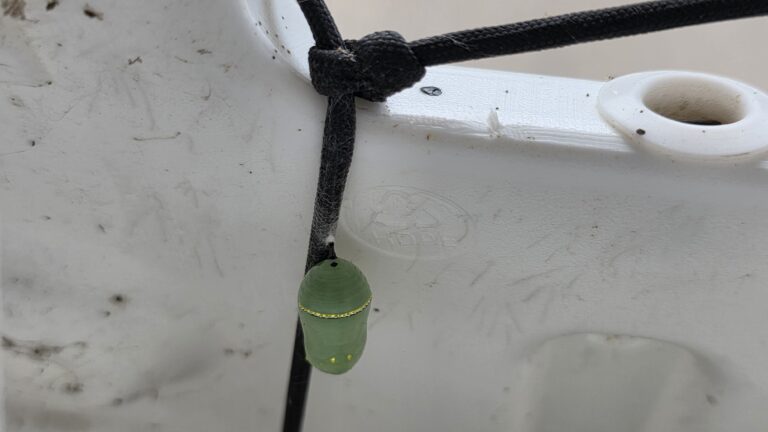


A monarch caterpillar and a monarch butterfly look so completely different that it’s hard to believe they’re the same animal. The change happens inside a chrysalis, but it isn’t as simple as a caterpillar growing wings.
The process is called complete metamorphosis, and monarchs go through four distinct life stages: egg, larva or caterpillar, pupa or chrysalis, and adult butterfly.
From Egg to Hungry Caterpillar
A female monarch lays her eggs on milkweed because newly hatched caterpillars need milkweed to survive. The tiny caterpillar that emerges has one main job: eat and grow.
Monarch caterpillars grow incredibly quickly. Because their outer skin can’t stretch enough to keep up, they shed it several times as they grow. Each stage between molts is called an instar. Monarchs go through five larval instars before they are ready for one of the most dramatic changes in the insect world.
How Does a Caterpillar Become a Chrysalis?
When a monarch caterpillar is fully grown, it stops eating and begins looking for a protected place to pupate. It spins a small silk pad and attaches itself using a structure at the end of its body called the cremaster. The caterpillar hangs upside down in the familiar J shape.
Then things get weird. The green chrysalis isn’t something the caterpillar builds around itself like a cocoon. It is actually revealed when the caterpillar sheds its larval skin one final time.
Underneath is the soft new pupal covering. Within a short time, it hardens into the smooth jade-green chrysalis with those beautiful metallic-looking gold spots.

What Happens Inside a Monarch Chrysalis?
This is the part that seems almost impossible. The caterpillar doesn’t simply sit inside the chrysalis while wings grow onto it. Its body undergoes an enormous transformation.
Does a Caterpillar Really Turn Into Goo?
Pretty much. And this may be the strangest part of the entire process. Once the monarch forms its chrysalis, enzymes begin breaking down much of the caterpillar’s larval tissue. This process is called histolysis. The broken-down tissue creates a nutrient-rich liquid inside the chrysalis, sometimes described as caterpillar soup.
But the caterpillar doesn’t completely dissolve. Some organs and parts of the nervous system remain, while tiny groups of cells called imaginal discs survive the breakdown. These cells were already hiding inside the caterpillar before it ever formed a chrysalis. Now they get to work.
Using nutrients from the broken-down larval tissues, the imaginal discs grow and develop into adult structures including the monarch’s wings, legs, antennae, and reproductive organs.
So there really is a stage when what’s inside that beautiful green chrysalis looks a whole lot less like a caterpillar or a butterfly and a whole lot more like primordial ooze. 😂 And somehow, from that mess emerges a perfectly formed monarch.
How Long Does a Monarch Stay in Its Chrysalis?
The pupal stage generally lasts about 8 to 15 days, although temperature and other conditions affect the timing. For much of that time, the chrysalis remains green.
Then comes one of the best clues that something is about to happen. Shortly before the butterfly emerges, the chrysalis becomes increasingly transparent. Eventually, the orange and black pattern of the monarch’s wings can be seen through it. The butterfly is almost ready.
Watching a Monarch Emerge
Recently, my friend Kerri and her sister found a couple of monarch chrysalises on milkweed plants growing in a carport and kept them protected while the butterflies developed.
Monarch adult emerging from its chrysalis. Video courtesy of Kayleah Gee.
One of the first things to watch is the monarch’s mouth. A newly emerged butterfly’s proboscis starts out in two separate halves. She repeatedly curls and uncurls it as the halves join together to form the long feeding tube she’ll use to drink nectar.
At the same time, she hangs from the empty chrysalis while pumping hemolymph into her crumpled wings. The wings slowly expand, straighten, and harden before she’s ready to fly.
Watching one emerge makes it much easier to understand just how much has happened inside that chrysalis. The adult splits the pupal casing and slowly works its way out. At first, its wings look small, crumpled, and nothing like the broad wings of a monarch flying through a meadow.
That’s normal. The newly emerged butterfly hangs while it pumps fluid called hemolymph into the veins of its wings. The wings expand and straighten, then need time to harden and dry before the monarch can fly.
Trying to “help” a butterfly out of its chrysalis can interfere with this process, so emergence is something best watched rather than assisted.
The Adult Monarch
Once its wings are ready, the monarch begins the adult stage of its life. Instead of chewing milkweed leaves as the caterpillar did, the butterfly uses a long coiled proboscis to drink nectar from flowers.
That makes late-season nectar plants especially important. Here at Bees Haven in Upstate New York, monarchs are still visiting the property in early September. Goldenrod and asters are providing nectar at a time when many summer flowers are already disappearing.
For migrating monarchs, those flowers aren’t just pretty. Nectar provides the energy needed for the journey south.
Why Milkweed Still Matters
Adult monarchs can drink nectar from many different flowers, but monarch caterpillars have a much more restricted diet. They need milkweed. That means a monarch habitat needs more than flowers for adult butterflies. It also needs the plants that the next generation of caterpillars requires.
A useful monarch garden provides both:
- Milkweed for eggs and caterpillars
- Nectar-rich flowers for adult butterflies
In the Northeast, having flowers that bloom from spring through fall helps support monarchs and other pollinators throughout the growing season.
One Butterfly, Two Completely Different Lives
It’s easy to think of the chrysalis as a little container where a caterpillar waits to become a butterfly. What is actually happening inside is much more remarkable.
In a matter of days, a crawling, leaf-eating caterpillar is transformed into a nectar-drinking butterfly capable of flight. And when a monarch finally splits open that transparent chrysalis and unfolds those orange-and-black wings, we’re seeing only the last few minutes of a transformation that has been happening out of sight for days.
🌿 Gear Up for a Bee-Friendly Garden
Contains affiliate links, for full disclosure, see FTC Disclosure, here.
Looking for tools that actually work?
We’ve pulled together our favorite picks for beekeeping, gardening, and pollinator-friendly seeds—everything you need to support bees and grow a thriving space.
Browse the full list on Amazon — all in one spot.