
For decades, scientists have studied monarch migration by placing tiny numbered stickers on their wings and hoping someone finds the tagged butterfly again. That method has taught researchers an enormous amount about monarch migration, but there can be hundreds or even thousands of miles between the places where a butterfly is seen.
Now, scientists have another tool. Tiny solar-powered radio transmitters are being attached to monarch butterflies, allowing researchers to follow the movements of individual monarchs much more closely as they migrate.
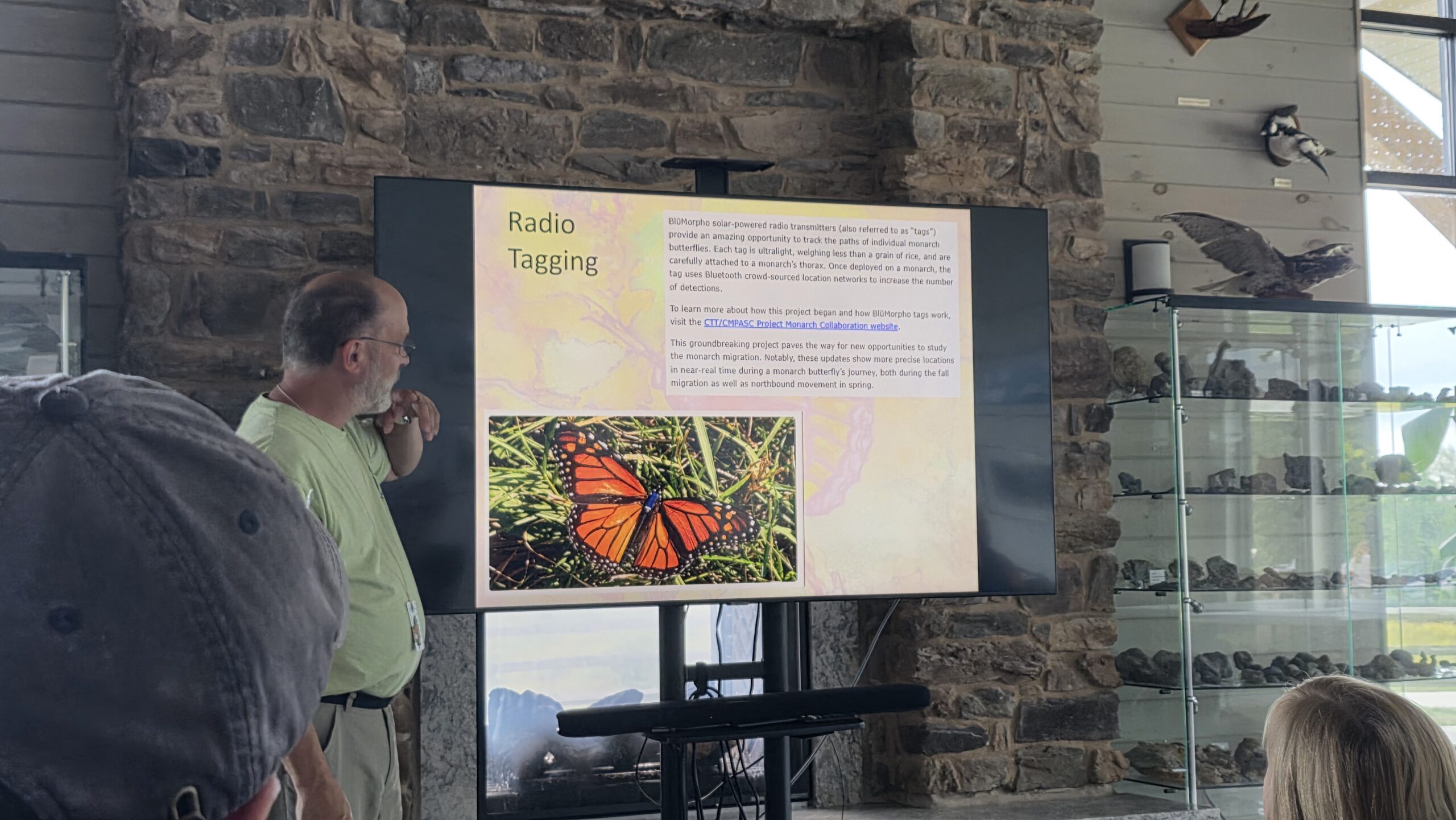
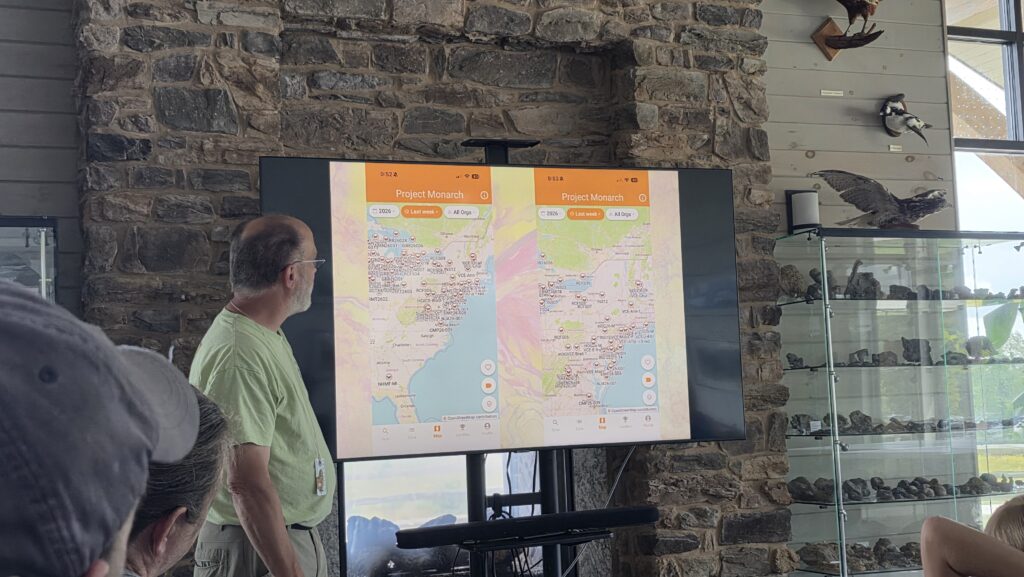
I learned about the technology at a recent monarch tagging workshop at Sterling Nature Center in Sterling, New York. Watching the actual routes of individual butterflies on a map was one of the most interesting parts of the presentation.
How Do You Put a Radio Transmitter on a Butterfly?
The transmitters are called BlūMorpho tags. They are extremely small, solar-powered radio transmitters developed specifically for tracking very small animals.
Instead of being attached to a monarch’s wing like a traditional Monarch Watch sticker tag, a BlūMorpho transmitter is carefully attached to the butterfly’s thorax. The transmitter weighs less than a grain of rice.
Once the butterfly is released, the transmitter can produce detections as the monarch travels. That’s a huge difference from conventional monarch tagging. A traditional tag tells researchers where a monarch was released and, if they’re lucky enough to recover it, where it was eventually found. Radio tagging can provide points along the journey.
How Are Radio-Tagged Monarchs Detected?
This is the clever part.
Researchers didn’t build a chain of special monarch-tracking towers all the way from Canada to Mexico. The BlūMorpho transmitters can take advantage of crowdsourced Bluetooth location networks to increase the number of places where a butterfly can be detected.
That doesn’t mean researchers have a continuous GPS line showing every foot a butterfly flies. Large gaps can still occur between detections, especially where few compatible devices are nearby. But when another detection occurs, researchers have another point on the map.
In March 2026, one radio-tagged monarch disappeared from detection in Mexico and wasn’t detected again until it was north of College Station, Texas. It had traveled approximately 735 miles between detections. Another female traveled about 353 miles in a single day between recorded locations. For something that weighs roughly half a gram, that’s pretty incredible.
You Can Follow the Monarchs Too
You don’t have to be one of the researchers to watch what happens. The free Project Monarch Science app allows the public to follow many of the radio-tagged butterflies. Each monarch has an identification number, and the app can show information including its sex, release date, most recent detection, and distance from its release point.
You can also view the butterflies on a map and follow individual monarchs as new detections are recorded. The app has another purpose too. Users can scan for radio-tagged monarchs nearby. If the phone detects one of the transmitters, it can upload that detection to the Project Monarch database.
In other words, ordinary people carrying phones can become part of the detection network. Notice the migration of this monarch. Deployed from Oswego, NY, it headed north over Lake Ontario, then started heading south, and our naturalist surmised it got caught in a storm and was blown off course, so it ended up in Wisconsin.
Where Did Radio Tagging Monarchs Begin?
The current project is called the Project Monarch Collaboration. It was founded through a partnership between the Cape May Point Arts & Science Center and Cellular Tracking Technologies and now involves more than 25 research and conservation organizations. Monarch Watch is one of the participating organizations.
The project expanded dramatically during the 2025 fall migration. More than 600 BlūMorpho transmitters were deployed during the 2025–2026 migration season, including more than 500 during the fall and another 150-plus before the spring migration.
Monarch Watch itself radio-tagged 30 migrating monarchs in Lawrence, Kansas, in September 2025. And then they waited.
One Radio-Tagged Monarch Made It All the Way to Mexico
One of those butterflies was MW001, a male monarch. When researchers caught him in Lawrence, Kansas, he weighed just 0.6 gram and had a forewing length of 53 mm. Researchers released him with his radio transmitter in late September 2025.
His migration wasn’t particularly fast. South winds slowed the butterflies, and the group didn’t reach Oklahoma until October 7 or Texas until October 21. MW001 kept going.
He eventually traveled about 1,360 miles from Lawrence to the Monarch Butterfly Biosphere Reserve in central Mexico, arriving there in early November. Researchers weren’t simply looking at two points representing Kansas and Mexico. They collected detections as an individual monarch moved south.
They Followed Monarchs Back North Too
The experiment became even more interesting in spring. Researchers attached transmitters to monarchs at their overwintering sites in Mexico and followed them as they began moving north again.
Some of the routes were anything but straight. One female reached Louisiana, traveled east through Mississippi and Alabama into Florida, then turned around and headed west again, eventually returning to Louisiana. Other monarchs took very different routes north.
Researchers also saw movements that appeared to coincide with changing winds. On March 12, 2026, strong easterly winds were accompanied by substantial westward movements. One tagged monarch was detected 119 miles farther west, while another was detected 224 miles from where it had ended the previous day.
That’s the kind of information traditional sticker tagging simply can’t provide.
Why Does Radio Tracking Matter?
Scientists already know the broad outline of monarch migration. Eastern monarchs travel south to overwintering areas in the mountains of central Mexico, and their descendants move north again the following spring. The harder questions involve what happens between the beginning and the end.
Which routes do individual butterflies choose? How does wind affect them? How quickly do they travel? Where do they stop? Do males and females behave differently? Why do two monarchs released from the same place sometimes head in different directions?
Radio tracking gives researchers a new way to investigate those questions. And because the transmitters can potentially provide many detections from one butterfly, researchers don’t have to depend entirely on someone physically finding a tiny numbered sticker hundreds of miles away.
What’s Next for Radio-Tagged Monarchs?
The technology is still very new, and researchers are already using it for questions beyond the fall migration. In 2026, Monarch Watch radio-tagged first-generation monarchs in Texas, Oklahoma, and Kansas to study how far north those individual butterflies travel.
That could help researchers understand another part of the monarch’s remarkable annual cycle. The butterflies returning from Mexico don’t simply fly all the way back to places like New York and Ontario. They reproduce along the way, and later generations continue the journey north. As many as five generations can pass before the Super Generation heads back south in late summer and early fall. So, the monarchs that migrate south have never flown that route.
For the first time, researchers can watch some of those individual movements unfold. And anyone with the Project Monarch Science app can follow along.
See our new articles on Our Monarch Waystation is 20 Years Old and Tagging Monarch Butterflies for more fascinating monarch facts.
🌿 Gear Up for a Bee-Friendly Garden
Contains affiliate links, for full disclosure, see FTC Disclosure, here.
Looking for tools that actually work?
We’ve pulled together our favorite picks for beekeeping, gardening, and pollinator-friendly seeds—everything you need to support bees and grow a thriving space.
Browse the full list on Amazon — all in one spot.