

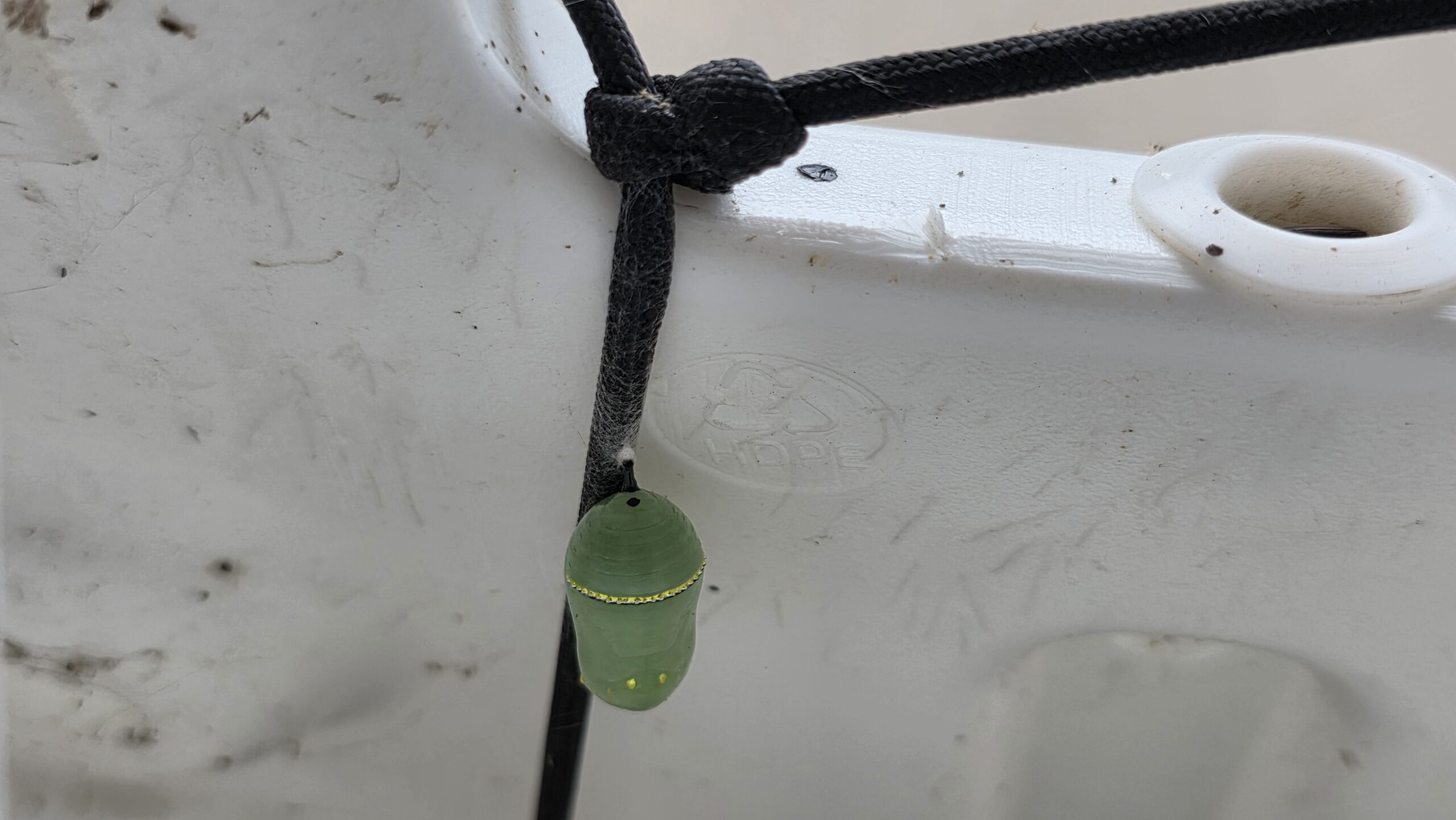
I recently attended a monarch tagging workshop at Sterling Nature Center on the shores of Lake Ontario in Sterling, New York. They hold three workshops each September to tag adult monarchs before their nearly 3,000-mile migration to the mountains of central Mexico.
The workshop began with a slideshow explaining the tagging process, how researchers collect data, and how to measure a monarch’s forewing. Then we headed outside with butterfly nets to see what we could catch.
Probably because of my entomology days, I managed to catch two monarchs, one male and one female. The male’s forewing measured 52 mm, while the female’s measured 50 mm.
Each butterfly was tagged, measured, recorded, and then released back into the wild.
How Does Monarch Tagging Work?
Monarch Watch has been tagging monarchs since 1992. The program uses small weatherproof stickers, each with a unique identification code. The tag is placed on the monarch’s hindwing, and information about the butterfly is recorded, including where and when it was caught, its sex, and now, its forewing measurement.
After the monarch is released, the rest is up to the butterfly. If someone finds or photographs the tagged monarch later in its journey, the tag number can be reported to Monarch Watch. Tags are also recovered at the monarchs’ overwintering grounds in central Mexico.
By matching a recovered tag with the original tagging record, researchers can determine where that monarch started its journey, where it was found, and how far it traveled. Over the years, this information has helped researchers study migration routes, the timing and pace of migration, survival, and the effects weather can have on the journey. More than 3 million monarchs have been tagged through the program since it began.
Why Do Scientists Tag Monarchs?
Monarch Watch started its tagging program to learn more about the monarch’s fall migration. It is a large community science project involving thousands of volunteers across the eastern United States and Canada. More than 3 million monarchs have been tagged since the program began.
The tagging program is a type of research called mark and recapture. A butterfly is caught, marked with an identifying tag, and released. If that butterfly is found again somewhere else, researchers can match the number on its tag with the information recorded when it was released.
That sounds simple, but when thousands of people do it over many years, the information adds up. Tag recoveries have helped researchers learn where migrating monarchs come from, when they migrate, how quickly they travel, and how weather affects their journey.
What Is on a Monarch Tag?
The tags we used were tiny round weatherproof stickers. Each one has its own unique series of letters and numbers so an individual monarch can be identified if it is seen again.
The tags are remarkably small, about 9 mm across, and weigh approximately 0.008 gram. An average monarch weighs around 0.5 gram, making the tag about 1.6 percent of its body weight. Monarch Watch has studied whether tagging affects survival and continues to research the effects of the tags.
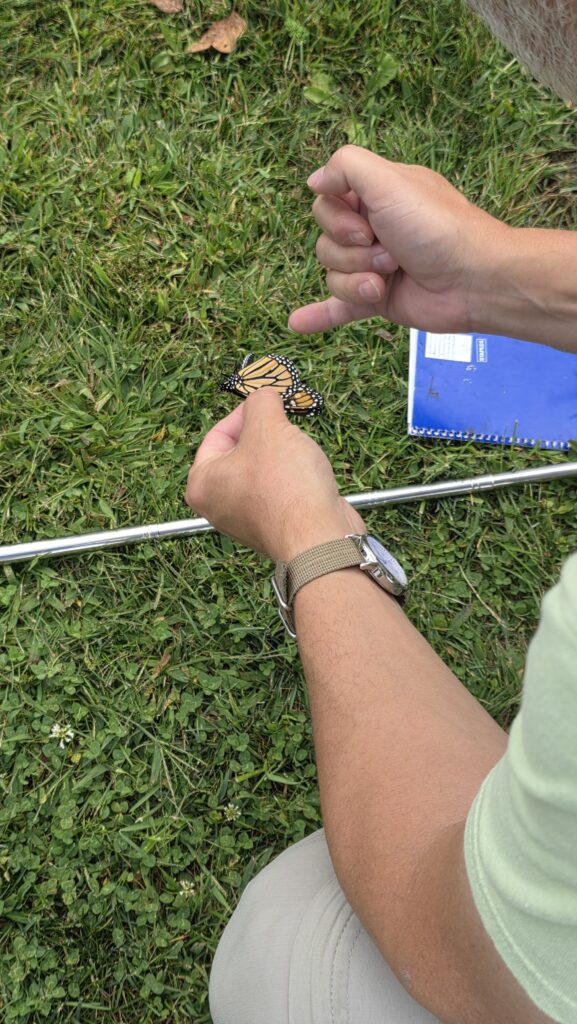
The tag is carefully placed over the large mitten-shaped cell on the underside of the hindwing. Once it is attached, the monarch can be released to continue its migration.
What Information Is Recorded?
Putting the sticker on the butterfly is only half the job. Each tag has to be matched with information about the monarch that received it.
For the two monarchs I caught at Sterling, we recorded the unique tag number, date, sex, whether the monarch was wild or reared, and the location where it was released.
Beginning in 2026, Monarch Watch added an optional forewing measurement to its regular tagging program. A small ruler is now included with tagging kits. Wing size can provide researchers with additional information about conditions during the butterfly’s development and may also be related to its success during migration.
Once the season is over, taggers submit their records to Monarch Watch, where the information becomes part of the tagging database.
What Happens After a Monarch Is Released?
This is where it gets interesting.
Nobody knows whether an individual tagged monarch will ever be seen again. It may travel hundreds or thousands of miles without another person encountering it.
But tagged monarchs are found along their migration route in Canada, the United States and northern Mexico. Others make it all the way to the overwintering grounds in central Mexico. When someone finds a tagged monarch, the unique number can be reported to Monarch Watch and matched with its original tagging record.
That can connect two dots on a map separated by hundreds or even thousands of miles.
In 2025, for example, a female monarch originally tagged in Maine was photographed again in Texas after traveling almost 1,700 miles.
And recoveries don’t necessarily happen immediately. In February 2026, a tag was recovered at the El Rosario overwintering sanctuary in Mexico that had been placed on a female monarch by a Kansas high school student in 1997. The butterfly obviously hadn’t survived 29 years. The tiny tag had remained at the sanctuary until someone found it nearly three decades later.
That’s a pretty remarkable amount of information to get from a sticker smaller than a dime.
A Monarch From Sterling Made It to Mexico
One of my favorite parts of the workshop was seeing proof that butterflies tagged right there at Sterling can complete the journey.
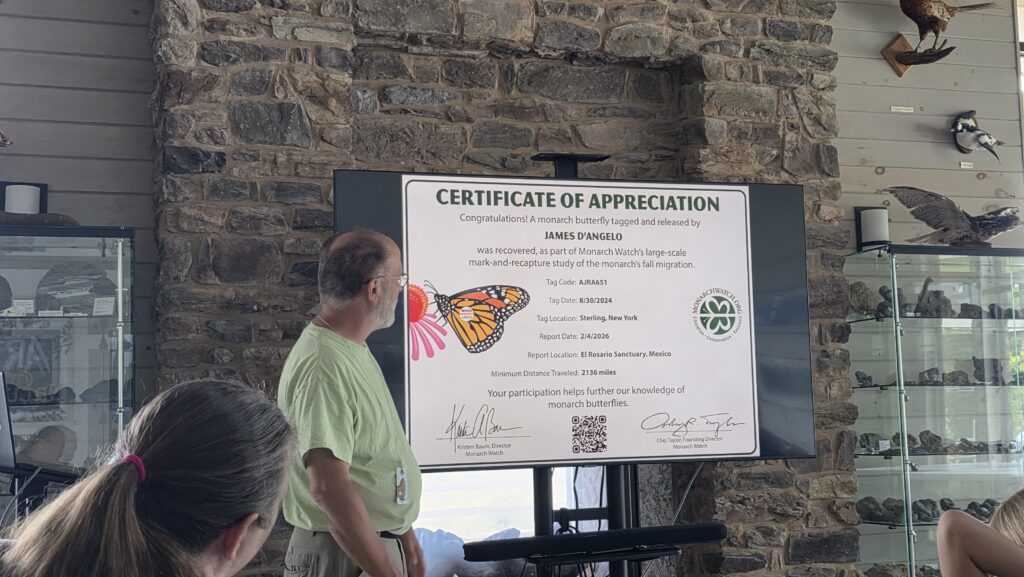
A monarch tagged at Sterling Nature Center on August 30, 2024, was later recovered at the El Rosario Monarch Butterfly Sanctuary in Mexico on February 4, 2026. According to the information presented at the workshop, the distance between the two locations was at least 2,136 miles.
That really puts the migration into perspective. A butterfly weighing roughly half a gram left the shore of Lake Ontario and eventually reached the mountains of central Mexico.
Can Anyone Tag Monarchs?
Yes. You don’t need to be a scientist or attend a workshop to participate.
Monarch Watch sells tagging kits to people east of the Continental Divide. The kits include numbered tags, instructions, data sheets, information about monarch migration and, beginning in 2026, a ruler for measuring forewing length.
There are some rules to follow. The tags are intended specifically for monarchs during the fall migration, and accurate recordkeeping is important. Monarch Watch asks participants to submit their completed tagging data after the season so the information can be added to the research database.
If someone encounters a monarch that has already been tagged, that is valuable too. Monarch Watch has an online form for reporting recovered tags, including monarchs found before they ever reach Mexico.
We’ll Be Tagging Monarchs at Bee’s Haven Next Year
After attending the workshop, I’ve decided to order my own tags and participate next fall.
Bee’s Haven has been registered as Monarch Waystation #764 since 2006, and we already have three species of milkweed along with acres of nectar plants for migrating adults. We see monarchs here every year, so tagging some of the fall migrants seems like a natural next step.
I’ll photograph the process, record the measurements, submit our data and then wait to see if one of our tags ever turns up somewhere farther south.
Maybe we’ll get lucky and one of our Bee’s Haven monarchs will eventually be found in Mexico!
🌿 Gear Up for a Bee-Friendly Garden
Contains affiliate links, for full disclosure, see FTC Disclosure, here.
Looking for tools that actually work?
We’ve pulled together our favorite picks for beekeeping, gardening, and pollinator-friendly seeds—everything you need to support bees and grow a thriving space.
Browse the full list on Amazon — all in one spot.
