

Male and female monarch butterflies look very similar at first glance. Once you know what to look for, though, telling them apart is surprisingly easy. The best clues are found on the hindwings, where male monarchs have two distinctive black scent glands that females don’t have.
How to Identify a Male Monarch Butterfly
The easiest way to identify a male monarch is to look for a small black spot on each hindwing.
These spots, located along a vein on the lower wings, are called androconial patches. They contain specialized scales associated with scent production.
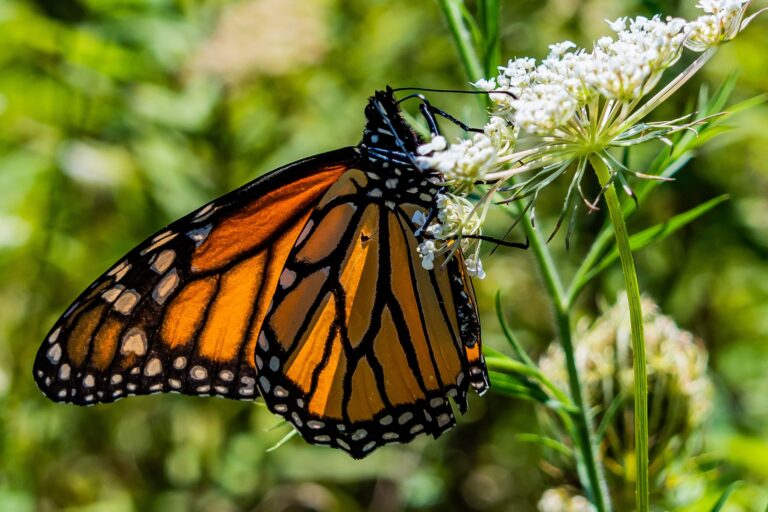
Male monarch butterfly above. The black scent patches can be seen on the veins of both hindwings.
Male monarchs also usually have thinner black veins running across their wings. When the butterfly has its wings spread like this one, both features can be quite easy to see.
What Are the Black Spots on a Male Monarch’s Wings?
Those little black spots aren’t damage, markings meant for camouflage, or anything stuck to the butterfly. They’re part of the male’s reproductive anatomy. The patches contain specialized scales associated with pheromones, chemical signals used in courtship and mating.
Here’s an interesting wrinkle: monarchs don’t rely on these scent glands as heavily as some closely related milkweed butterflies do. Male monarchs still have the structures, but visual and physical courtship behavior also plays an important role in mating.
So those two little black dots are useful to the monarch, but they’re especially useful to us because they’re the easiest way to tell a male from a female.
How to Identify a Female Monarch Butterfly
Female monarchs do not have the black scent patches on their hindwings.
Their black wing veins also tend to be wider and darker than those of males. Put a good male and female photograph next to each other, and the difference in the veins becomes much easier to see.

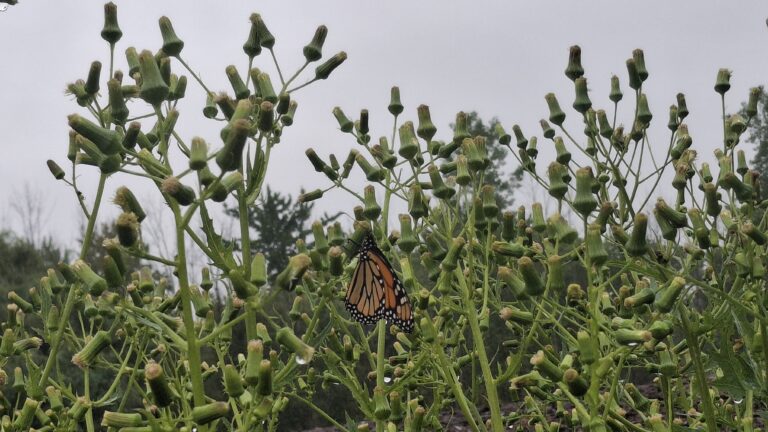
Female monarch butterfly. Notice the absence of black scent patches and the heavier black veins.
The scent patches are the better field mark. Wing-vein thickness can vary somewhat and can be harder to judge depending on the light, angle, and condition of the butterfly.
Male vs. Female Monarch Butterfly
| Male Monarch | Female Monarch |
|---|---|
| Black scent patch on each hindwing | No scent patches |
| Generally thinner black wing veins | Generally thicker, darker wing veins |
| Does not lay eggs | Lays eggs on milkweed |
Can You Tell the Sex When Their Wings Are Closed?
It can be harder. With a good side view, some of the differences may still be visible, but an open-wing photograph is much better. If the butterfly won’t cooperate, take several photos or a short video. One frame may catch the wings in exactly the right position.
Why Knowing the Difference Is Useful
You don’t need to know whether every monarch visiting the garden is male or female. But once you learn the markings, it becomes fun to keep track.
Females visiting patches of milkweed are particularly interesting to watch because they may be searching for places to lay eggs. Males may patrol areas where monarchs congregate, looking for potential mates.
Watching individuals over the course of the season can also provide a clearer picture of how monarchs use a property, not just which flowers they’re visiting.
Look at the Hindwings First
If a monarch gives you a good look at its open wings, forget everything else for a second and look at the hindwings. Two little black scent patches? Male. No patches and heavier black veins? Female. Once you learn those two clues, you’ll probably start sexing every monarch you see.
Are you interested in learning more about Monarch butterflies? See our article on How a Monarch Caterpillar Turns Into a Butterfly or A Rare Win Story for Monarch Butterflies.
🌿 Gear Up for a Bee-Friendly Garden
Contains affiliate links, for full disclosure, see FTC Disclosure, here.
Looking for tools that actually work?
We’ve pulled together our favorite picks for beekeeping, gardening, and pollinator-friendly seeds—everything you need to support bees and grow a thriving space.
Browse the full list on Amazon — all in one spot.