
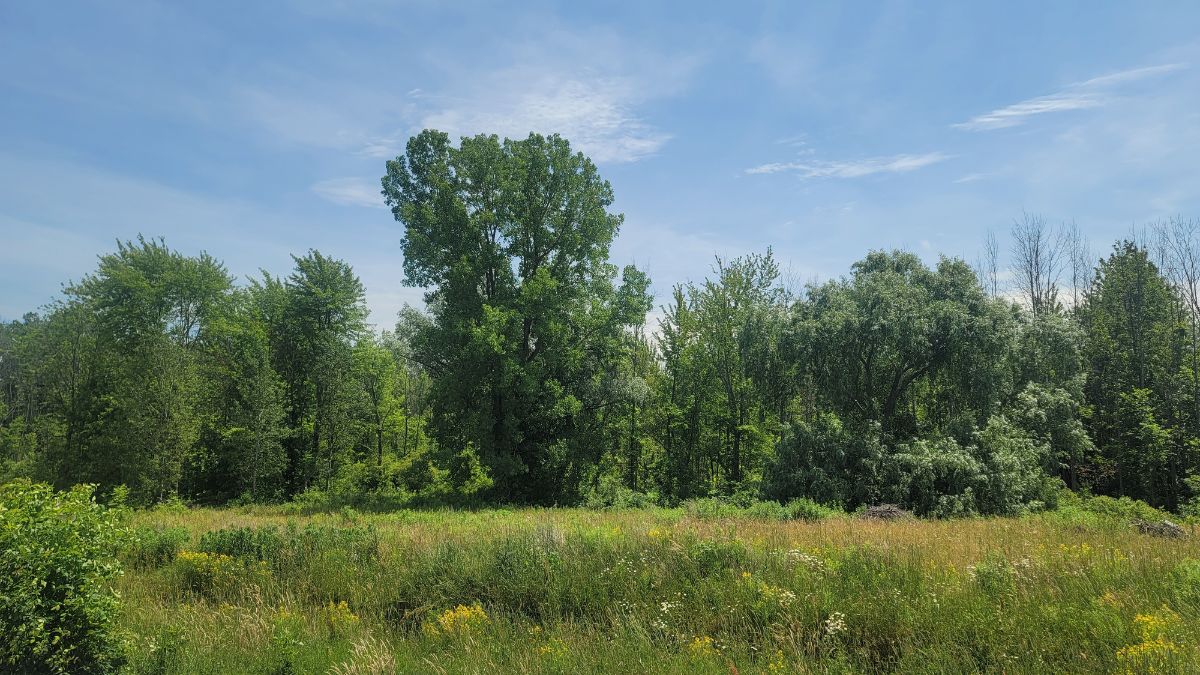
The wildflower meadows at Bees Haven make up some of the most visible and active parts of the property. These open areas, once used for hay and crops, now support a thriving wildflower meadow habitat full of native plants, bees, butterflies, insects and birds.
Higher Ground and Sunlight
Most of the meadow zones are located on slightly higher ground. That gives them better drainage and full sun, which are ideal conditions for a variety of wildflowers. These areas respond well to periodic bush-hogging, which we perform every few years to prevent woody growth and weed trees, such as Box Elder (Acer negundo), that we discussed in the last article, from taking over.
Plants Found in the Wildflower Meadows
Over the years, native species have made a strong comeback. You’ll find lots of milkweed (Asclepias syriaca), goldenrod (Solidago spp.), black-eyed Susans (Rudbeckia hirta.), and New York asters (Symphyotrichum novi-belgii). The southern field has a high concentration of rudbeckia and daisy fleabane (Erigeron annuus). Other areas include patches of yarrow (Achillea millefolium), wild bergamot (Monarda fistulosa), white clover (Trifolium repens) and red clover (Trifolium pratense). These plants don’t just look pretty, they’re essential for feeding bees, butterflies, insects and mammals.
Pollinators and Wildlife
The fields stay busy. Monarchs and other butterflies visit regularly in summer. Native bees of all sizes nest in the ground or under logs. Bumblebees love the clover, and solitary bees, such as leafcutters, are common too. You’ll also see dragonflies, hummingbirds, and mammals.
At night, bats skim low over the flowers, feeding on insects. And lightning bugs flash across the fields, especially in June and early July. These open spaces with minimal light pollution make perfect habitats for them, which is more important than ever, given that fireflies are declining across the country.
The video features fireflies in the large meadow south of the restoration area, taken on June 29, 2025, at 10:30 pm. It starts when it is almost dark. You can see the silhouette of the large trees in the wet woodland. It ends when it is pitch dark on the same evening at about 11 pm. The video doesn’t do it justice compared to the naked eye, but you see how many there are. Tens of thousands is my estimate.

You may be interested in joining The Firefly Conservation and Research Organization.
Large South-West Meadow
The south meadow differs from the smaller meadow described above because it is on lower terrain. The result is that most of this field stays wet for a big part of the year. The soil is very clayey and doesn’t drain well. Between the field and the swamp lies a hump where large patches of blackberries grow, resulting in pooling water since it cannot drain into the swamp or the wet woodland to the east. The other major factor is that the higher areas become extremely dry and harden like concrete due to the clay in the summer, so the plants must be resilient.
Many species struggle to succeed in this field. The plants that thrive are the grasses, Pussy willow (Salix discolor), Red osier dogwood (Cornus sericea), black cherry (Prunus serotina), buttercup (Ranunculus spp.) and black-eyed Susan (Rudbeckia hirta).
Large South-East Meadow
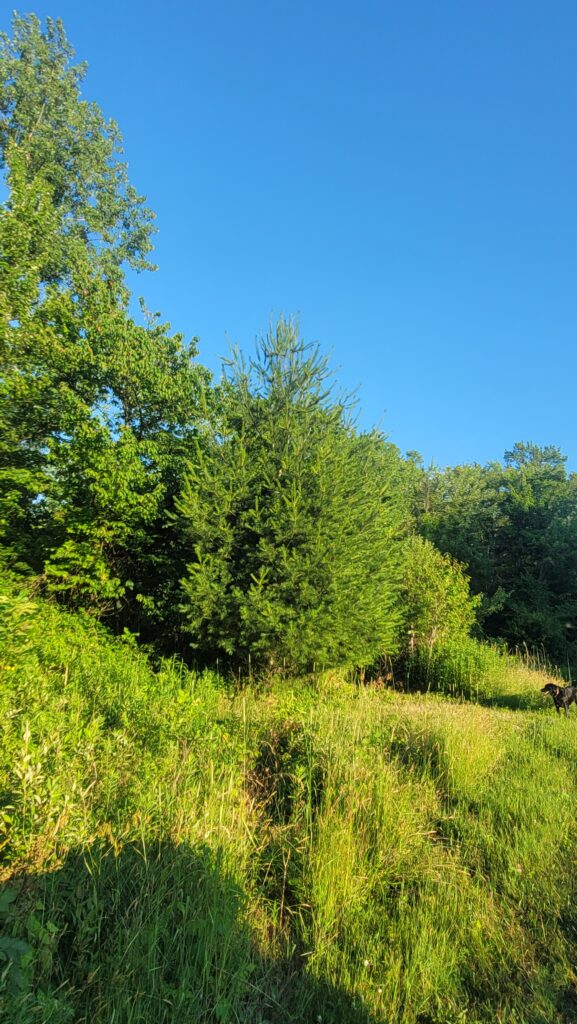
The South-east meadow sits on higher ground. It has a sloping terrain with hills on either end. (We use “hills” loosely here since the elevation is only about 250 feet above sea level.) This field is loaded with blackberries (Rubus spp.), staghorn sumac (Rhus typhina) and invasive autumn olive (Elaeagnus umbellata). Grasses, cornflower (Centaurea cyanus), New England aster (Symphyotrichum novae-angliae) and
The blackberry patches and black cherries in particular are perfect to support both pollinators and birds, small mammals and even deer. Deer forage on them all year round.
Management and Maintenance
We let the wildflower meadows grow naturally, but keep them in check with rotational bush-hogging. We avoid mowing during peak bloom seasons, generally waiting for late fall, and never use herbicides. They are only mowed one field per year because the seeds are an important winter food source for many species of birds and mammals. This approach enables native plants to establish themselves while keeping invasive shrubs, such as multiflora rose (Rosa multiflora) and autumn olive (Elaeagnus umbellata), at bay.
The results are very clear. Every year, we see an increase in flowering species and a rise in wildlife using the land. These meadows are not just beautiful; they’re functional spaces that support biodiversity and provide pollinators with room to thrive.
Note: The image at the beginning shows the wildflower meadows featured in the video during daylight hours.
These meadows are just one part of our effort to restore Bees Haven’s 29 acres for wildlife, and we hope you’ll follow along as we share more about each habitat zone.
See our first article in this series. What 29 Acres of Habitat Can Really Hold and the Pond, Creek Wildlife and the North Meadow at Bees Haven.
Want to keep your garden thriving? See our tips on vegetable garden maintenance.
🌿 Gear Up for a Bee-Friendly Garden
Contains affiliate links, for full disclosure, see FTC Disclosure, here.
Looking for tools that actually work?
We’ve pulled together our favorite picks for beekeeping, gardening, and pollinator-friendly seeds—everything you need to support bees and grow a thriving space.
Browse the full list on Amazon — all in one spot.


